The Limits of Educational Research – Part 1: John Sweller

pexels-photo-707676.jpeg

Stop all the clocks, cut off the telephone,

Prevent the dog from barking with the juicy bone.

Silence the pianos and, with muffled drum,

Bring out the school bell. Let the learners come.

(Adapted from, and with apologies to, WH Auden)

Few people who hear the poem adapted above, realise that WH Auden originally wrote it as a piece of satire, mocking the sort of eulogies that are  delivered for public figures who don’t really deserve them.  The fact that the poem is often seen as and used as, a heartfelt tribute at funerals, suggests that it is easy to misrepresent  a poet’s intentions by making use of their work in such a way that its original meaning is lost, and the same might be said of educational research. John Sweller’s work on cognitive load is often promoted by a group of teachers and researchers who have come to be identified as “the neo-trads” or neo-traditionalists.  However, just like when a legion of summative assessors leapt misguidedly upon the Black and Wiliam Black Box and nearly broke the system with their enthusiasm for inefficient assessment of work and learning, so we need to be careful before doing the same with Sweller’s work on Cognitive Load Theory (CLT).

Sweller is working just as hard as Wiliam did in correcting misunderstandings about his work. Like any good researcher, Sweller acknowledges the limitations of his work. And it is these limitations which fail to cross the divide from research to school teaching that we need to pause and reflect upon.

Many people forget that Sweller accepts the constructivist view of learning – namely that we learn because of a set of mental structures (often referred to as schemata) which allow us to construct meanings and information from that which we perceive of the outside world. The difference for Sweller is what this means for teachers. For social constructivists, like Jerome Bruner, this construction is facilitated through the individual’s interaction with others and the world they inhabit. It is a journey of discovery rather than a  guided path. For Sweller, this is the problem. The mental structures with which with he is concerned need to be built in a particular way, and this is where the teacher comes in. They must teach certain things in certain ways which develop the architecture of the schema, allowing them to be stored in the individual’s long term memory. For Sweller, teaching methods which allow students to discover things for themselves do not do this.

But…..Sweller is clear that his ideas do not constitute “ a theory of everything”. Most of the data which supports his theory comes from the subject domains of Maths and Science. He doesn’t feel that Cognitive Load Theory works as a way of informing instructional design unless what is being learnt has a high level of what he calls “element interactivity”, namely, the number of different elements that must be considered simultaneously in the instance of learning – say, something like a complex equation. Interestingly, an Australian academic called Arianne Rourke has tried to apply Sweller’s ideas to the Art classroom , but only in the sense of using worked examples to teach students about the history of design and designers – an area of Art education that we might see as being largely a matter factual information, rather than the affective matter of expression or interpretation.

The real problem with CLT then, would appear to be its adaptability and scalability. Can it, as a basis for instructional design, be adapted to subjects like Drama, Geography or DT? Probably not, though it might be worth thinking about areas of these subjects where CLT might have an application? Could it be scaled properly across schools so that everyone was using it to inform their teaching? Again, probably not, but some teachers might benefit from thinking about cognitive load and where this idea was advantaging or disadvantaging learning.

The Parnassian Phoenix and the GCSE Language Carpet

pexels-photo-164446.jpeg

If you recognise words in that headline, there’s a reason. It’s an intertextual reference to Edith Nesbit’s Phoenix and the Carpet combined with an obscure movement in reaction to Romanticism used as an adjective in a pejorative sense. It then takes the GCSE Language and suggests it is on the floor, on the carpet, knocked down by some unknown force which I am about to expound upon. Or perhaps the carpet is the new GCSE Language itself, exciting and new at first, but once the Phoenix makes it a magic carpet it starts to get frayed with the children constantly having adventures with and on it, wearing it out.

I am referring to the nonsensical GCSE Language exam revision that we are seeing in a pseudo norm referenced scramble to meet the criteria in a better way than around 55% of one’s national peers. Children learning ever more complex and obscure language devices to better impress the examiner. I remember studying Parnassianism at university, its weakness and how well that resonated with me as a reader. In a nutshell, the surface of the Parnassian text is so ornate, so layered with technical features, that it obscures the actual meaning the text is trying to convey to the reader due to an opaque and impenetrable layer of verbosity. Hopkins uses it to describe competent but uninspired poetry.

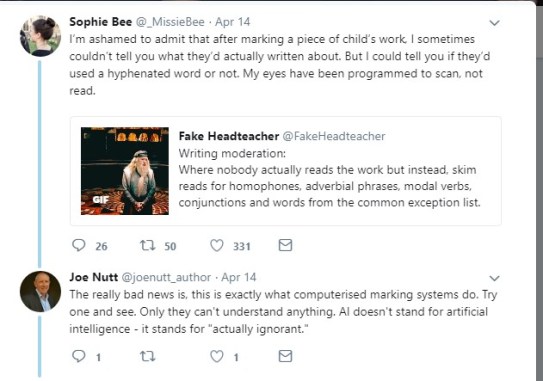
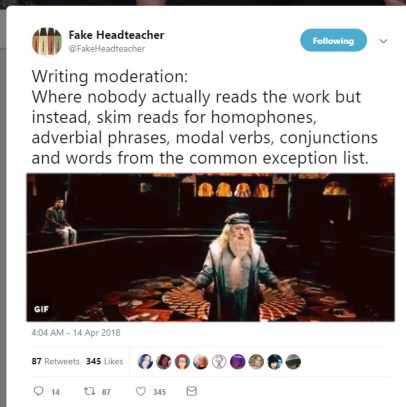
I’m not alone. The Fake Headteacher posted a tweet which provoked a nerve:

Fake Headteacher

This started a debate partly inspired by OFSTED’s conversion to machine learning. Is the future of English Language GCSE marking one where a machine is counting the techniques? Is this what good writing now looks like?

Sophie and Joe

@_MissieBee and @joenutt_author both raise really important points. In a modern world of fake news and bot authors, we are not developing original authors. We are in effect developing bot authors. Writers whose work can be read by bots with no recognition of thought and ideas. How we can get them to appreciate the new A02 phrase from AQA ‘effects of writer’s methods to create meanings’ over in GCSE Literature if we are not doing the same in GCSE Language?

Double or Quits: Triple Science and the Ethical Dilemma

cube-six-gambling-play-37524.jpeg

It is a straight forward choice isn’t it? If you intend to do sciences at A level and beyond you should be doing triple science: that holy trinity of Physics, Biology and Chemistry. If you don’t, you should do double science. Right? Well, there are some ethical points to consider.

If you want the best outcomes, grade 7-9s in your science subjects, then don’t forget there are only so many to go around give or take a couple of percent. Despite OFQUAL’s constant assurances that we have not returned to norm referencing, they are still adjusting the grade boundaries to ensure that results are broadly similar from year to year. Guess where all those top setters Grade 7-9s are? Those pupils benefitting from value added top set status,private coaching and determined aspirations are all in triple science! Looks like a blood bath for those top grades over there. If you are thinking of trying to manipulate your Progress 8 outcomes what might you put your pupils in for? Double Science of course! However, you should not be doing what’s best for the school should you – it should be what’s best for the pupil, right? And if that means cramming three subjects into the same amount of subject time as two subjects then so be it.

Yes – three subjects spread over the same time as two subjects. You might ask questions: what exactly are they learning in triple science that they are not learning in double science and is it really the best preparation for A level sciences and science in higher education? What about those who do double science but would be just as good for A level as the potential Year 8 (options are earlier every year) or year 9 pupils sitting there and thinking about their options. Would not exposure to some triple content  put you at an unfair advantage over your peer who completed double science? I hear the “I told you so. They are not up to A-Level” – well if they had a second bite of the cherry they may have been fine!

Speaking at the 2018 ASE conference, Amanda Spielman said some schools are wasting talent by putting the choice of triple science and A-level  in the hands of attainment and not aspirations. Curriculum or attainment – what should be the driver of choice?