10 things they hate about your subject

pexels-photo-256548.jpeg

Does it worry you when a pupil says they hate your subject? It should. That’s a strong word hate. And then applied to your subject like a knife in the heart. Nobody should be hating a subject. They especially should not be hating your subject.

Well actually, they hate performing in your subject.

They hate performing in P.E.

They hate writing for the view of others.

They hate reading aloud.

They hate doing maths and showing their working out publicly.

They hate taking exams in your subject.

In all of these, they hate performing in your subject. They hate publicly displaying: their body, their misconceptions in maths, their ineptitude in speaking modern languages, their poor reading aloud in front of others and their difficulty writing out their ideas; for public ridicule as they see it.

So who are ‘they’? They are pupils and adults who have had a negative experience of performance in your subject and have developed an aversion to it. This can be especially cemented when they do the final performance – the examination or assessment. And all of this fits into the contemporary agenda of mental health, but don’t think it is a new problem. It’s just modern life involves more performance these days.

Pupils who dislike performance based aspects of a subject can be found in any room of people. I’ve met so many people who tell me a variation along the lines of: ‘I had a negative experience performing in an area of a subject and this has affected me in all walks of life.’ These people make life choices, career choices, struggle in specific relevant situations and employ avoidance of activities & circumstances: a life time of different experiences all rooted in a negative experience of performing in a subject at school, e.g. ‘I didn’t like speaking in front of the class and now I avoid all public speaking wherever possible.’ I meet TEACHERS who don’t like public speaking. It’s a real thing this is. Teachers!

This must not be confused with the stretch and challenge agenda.  This agenda is focused on removing differentiated learning outcomes. A good teacher knows exactly where a pupil’s comfort zones and barriers to learning are. They engage with the pupil using a high quality relationship to create trust. Once established, they then use that trust to take the pupil beyond their comfort zone in such a way that the pupil feels supported and stretched at the same time.

One question I find helpful to ask myself is this: do I want them to read 3 books or 1000 books? If I want to achieve the latter, then I need to find a way to ensure a pupil enjoys the performance of reading. Does a P.E. teacher want the pupil to play the sport in school and never again or do they want them to enjoy sport itself for life? We have to think about the long term outcomes even when we are thinking about assessment outcomes. It is important – we need to achieve both the outcomes (performing in assessment) and the inspiration (performing in life) together. There is no good in having one without the other.

Don’t forget there is a good side to performance – I am not saying performance is a bad thing. I read an interesting article on science experiments which said the reasons for doing experiments are a mix of learning and of generating curiosity, motivation and an interest in chemistry. It suggests that when children meet challenge, if they have enjoyed challenge before in the subject they are more likely to persevere and to have better self-efficacy. It is a bit like doing a five kilometre run and then going home and doing some quite difficult mathematics made much more interesting by the fact that your five kilometre running performance has provided the data. Successful performance is brilliant. Life changing. Inspiring. Alas, so is a negative experience of performance and not in a good way.

The next time you meet a child or adult who dislikes your subject, ask some questions. What is it they don’t like? Is it a performance aspect? Is there a single incident which has taken root and created this aversion? Install a new updated experience of performance. One in which they are taught properly this time. Don’t let them move forward still hating your subject: for the rest of their lives.

Be like #GarethSouthgatewould – teach them to own the process.

I resign! How teachers now grow their careers with disloyalty

numbers-money-calculating-calculation.jpg

I am serious: teachers need to be disloyal more often if they want their careers to grow and their working terms and conditions to be healthy.

Ask yourself; if you stay with your car insurance provider, bank, phone, TV, car breakdown, electric or gas provider or any other provider – are you rewarded for your loyalty? No. Instead, you are seen as a cash cow. Every time you roll over the insurance or keep your ISA unchanged what happens? They up your premium. They lower your interest rate paid. The people getting the best deals are those shopping around. It isn’t actually necessary to switch. You simply get yourself a fresh quotation, pick up the phone and call your current provider asking to be put through to ‘cancellations’. Once there, you cite your fresh quotation and offer them the opportunity to match it. If you can’t be bothered to do this for any of your providers, then you only have yourself to blame when they raise their prices just for you and not the others.

And now the same is true for teachers. You need to be shopping around for schools. There are many schools that are very keen to recruit. They have a shortage of teachers and a shortage of teachers who will take the stress and accountability of Teaching and Learning Responsibilities. They might offer you an extra point on their payscale – just for coming to work for them. They might offer you a TLR responsibility which enhances your career. They might inflate your position: Assistant Headteacher status and you only have to be a Head of Department?  They are incentivising it for you. But are they doing this for the staff they already have? Not always, no. Ms Loyal Teacher is often looked over for that TLR. She will have to fight hard for the pay progression and then half the time not actually get a payrise – the school simply can’t afford it. However, if you are a good teacher and you get a good offer – well along you go to the SLT and see if they will match the offer.

Now I must point out that I don’t agree with this. Teachers who see a year group all the way through their time in the school are worth their weight in gold. Pupils like it, parents like it and yes, teachers like it. The best behaviour management, the most accurate differentiation and the best teaching comes from those who have taught the same children all the way through their school journey as part of a stable teaching team. The quality of relationship between the teacher, the children and the families of those children really does drive a better experience for all. Indeed, many teachers and dare I say it utility bill payers, would be much happier with a system that rewarded loyalty not disloyalty.

However, just like we have to be disloyal with our insurance, banks, utilities and other providers, so we now need to be disloyal with our school employers. Hopefully, it just takes calling the cancellation hotline to get you better working conditions, but what is the truth? I change home insurance, utility providers and the like just as regularly as I keep the provider after shopping around. The game has changed and teachers who stay in the same school are not doing their careers and working conditions any favours. It used to be that you would stay in the school and earn the right for extra money or responsibility. Now you need to leave, shop around and find new school employers who appreciate your fine teaching skills. For a year or two anyway.

Update:

Since publishing this blog we have seen the Dfes report come out which shows fewer teachers in the profession which is being driven by those leaving the profession not being offset by those entering the profession. The NFER blog shows that in particular, it is those teachers of working age leaving, not retirees that are causing the issue. The number of teachers aged 50+ has gone down from 23% to 17% in 2017. The question now is whether it is a normal part of modern culture to move around, not just within education, but from education to other industries. Certainly, maths and physics teachers are leaving teaching to earn more money elsewhere according to Sam Sims at Datalab.

Is the answer to incentivise those in the profession to stay in the profession? To stay in their schools? Currently, we are incentivising entrants to the profession to enter and only 67% of them are staying. Could some of that money be better spent elsewhere? Could those who stay in the profession for a very long time be rewarded with an earlier pension age? Could we award some kind of pecuniary bonus for those who achieve lengthy landmarks of time in a school or the profession?

Part of the problem has to be that some people think that headteachers are ‘moving staff on’ to help balance the books or because they feel staff have stagnated and need moving on. These people are the most expensive teachers at the top of the UPS band. Could the dreaded ‘capability’ rule be amended to afford more protection for those at the top of the scale when or if they stagnate? Laura McInerney says: “It’s not just about stagnation, I think you can become a less good teacher if you are given a bonkers timetable, an unsupportive department lead or zero resources.”  Whether it is true or not, the image that older experienced teachers are being pushed out of schools could mean some are jumping rather than waiting to be pushed – and jumping right out of the profession.

Keeping teachers in the profession and spending less doing so is a goal that unites the political spectrum. The drumbeat is firmly on entrants at the moment, but we have got see it is more than workload that is driving teachers out of the profession.

Understanding the effect of the Autonomous Nervous System on children’s behaviour

behaviour management

One model of explanation often applied in determining the learning and behaviour of any  child is the state their Autonomous Nervous System (ANS) is in. It is worth knowing a bit about this as the ANS gene expression is changed by poor early attachment experiences, excessive stress and trauma.

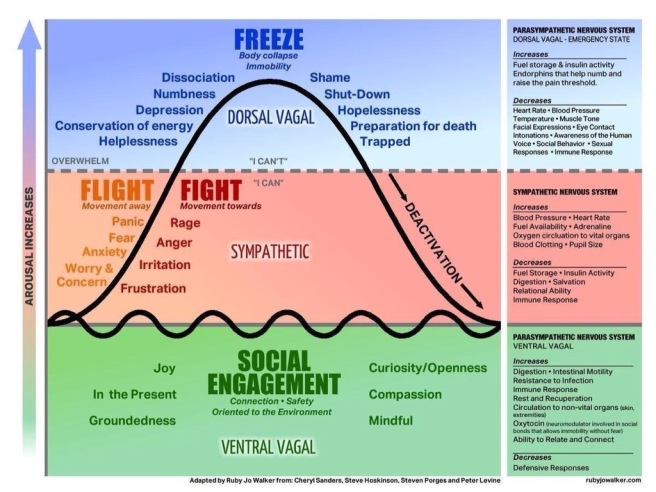
In any situation, a child’s brain is neuroceptively (fast and unconsciously) assessing environmental safety.  Many children find school a reasonably safe place and respond accordingly; some will find school and learning unsafe. This blog does apply to all children, but focuses by illustration on children who have experienced adverse childhood experiences. If a child’s  life  means that their experience of things is fraught with danger signals, then the child’s ANS will be sending danger signals to the rest of the brain and to the body. The child will then excessively look for danger in the EXTERNAL environment and excessively experience danger INTERNALLY – even from the most unfathomable of stimuli; when we experience an internal feeling of danger we tend to look externally for the source. This chart by Ruby Jo Walker highlights it well.

IMG_0435

According to Stephen Porges, who has pioneered work on the role of the vagal nerve, the ANS operates on a continuum of response from complete safety to extreme danger. It is helpful to divide this up into three zones of SAFETY, DANGER and LIFETHREAT. When the ANS judges both internal and external environment to be safe then this represents a child’s optimal arousal level. In this state, the child is most ready to learn. This is not about an element of challenge or stress but the assessed absence of danger. It is this state, that most children are in when in school, that is elusive for the child who has experienced significant adverse life experiences.

A child with the above issues exists far more with the ANS in a state of readiness for danger or even life threat – even if no such threat exists in the environmentA danger state is represented by hyperarousal and readiness for fight, flight, rage or panic. A life threat state is represented by hypoarousal, freeze, dissociation and collapse. When someone has an extreme phobic response to a relatively innocent stimulus then this is what is happening.

This understanding sheds some light on the issues surrounding these often very difficult to manage children. We tend to look at our external environmental strategies to see if they will work and often cannot see why they don’t work. However, these strategies simply will not work if the ANS is experiencing the external or internal child environment as dangerous. Where does this leave us then? Our focus needs to be on getting the ANS in the right place rather than on the poor behaviour resulting from the ANS response. Quite simply we also would behave in inappropriate ways if our ANS was misfiring in this way. When working with these children it is helpful for us to acknowledge poor behaviour and response to learning as adaptive rather than maladaptive. That leads us to the question, ‘Why might this behaviour be adaptive?’. Once we have asked ourselves that question it can lead us forward in our search for good solutions.

We can take three routes to modifying the ANS response and in ‘learning the child’, we can try to find the right combination of routes. The first route works primarily on the body and physiological response generated by the ANS. The second route works primarily on the emotional state itself to create a sense of safety. The third route works on the cognitive (executive function) ability to apply a brake to the ANS. This whole brain way of working represents a powerful model for working with these children.

 As teachers we need to ‘stand still in order to move on’. This means finding the time to stand back and ask the question ‘ Could this behaviour be signalling something more than is immediately obvious? By being prepared to view behaviour as a signal of adaptation gives us the space to become thoughtful and reflective rather than reactive. It enables us to be better teachers and children to learn better.

Having run a workshop on this a number of times it has become clear educators need solutions. The main solution is re-labelling the behaviour you see as fight or flight. Imagine someone with a propensity for car rage next to you in a car, raging at the traffic – how do you talk to them? What makes them worse? Tell them to stop swearing and they’ll swear directly at you in response! What about if there was a child on a climbing centre rock wall, frozen mid climb? How would you talk to them? What would you say? You certainly wouldn’t threaten them with a sanction if they didn’t move forward! You tell them about how the rope is making them safe. That everyone does this every day and is always safe. To take their time and then when they are ready take tentative steps. Relabel the behaviour and then approach the situation with the right tools. Once you have a relationship, they’ll respond quicker to you when you use the tools. It’s hard having a heightened ANS system, be sympathetic to them. Recognise how hard it must be to live life on the edge of fight or flight constantly and how that gets in the way of learning.