I resign! How teachers now grow their careers with disloyalty

numbers-money-calculating-calculation.jpg

I am serious: teachers need to be disloyal more often if they want their careers to grow and their working terms and conditions to be healthy.

Ask yourself; if you stay with your car insurance provider, bank, phone, TV, car breakdown, electric or gas provider or any other provider – are you rewarded for your loyalty? No. Instead, you are seen as a cash cow. Every time you roll over the insurance or keep your ISA unchanged what happens? They up your premium. They lower your interest rate paid. The people getting the best deals are those shopping around. It isn’t actually necessary to switch. You simply get yourself a fresh quotation, pick up the phone and call your current provider asking to be put through to ‘cancellations’. Once there, you cite your fresh quotation and offer them the opportunity to match it. If you can’t be bothered to do this for any of your providers, then you only have yourself to blame when they raise their prices just for you and not the others.

And now the same is true for teachers. You need to be shopping around for schools. There are many schools that are very keen to recruit. They have a shortage of teachers and a shortage of teachers who will take the stress and accountability of Teaching and Learning Responsibilities. They might offer you an extra point on their payscale – just for coming to work for them. They might offer you a TLR responsibility which enhances your career. They might inflate your position: Assistant Headteacher status and you only have to be a Head of Department?  They are incentivising it for you. But are they doing this for the staff they already have? Not always, no. Ms Loyal Teacher is often looked over for that TLR. She will have to fight hard for the pay progression and then half the time not actually get a payrise – the school simply can’t afford it. However, if you are a good teacher and you get a good offer – well along you go to the SLT and see if they will match the offer.

Now I must point out that I don’t agree with this. Teachers who see a year group all the way through their time in the school are worth their weight in gold. Pupils like it, parents like it and yes, teachers like it. The best behaviour management, the most accurate differentiation and the best teaching comes from those who have taught the same children all the way through their school journey as part of a stable teaching team. The quality of relationship between the teacher, the children and the families of those children really does drive a better experience for all. Indeed, many teachers and dare I say it utility bill payers, would be much happier with a system that rewarded loyalty not disloyalty.

However, just like we have to be disloyal with our insurance, banks, utilities and other providers, so we now need to be disloyal with our school employers. Hopefully, it just takes calling the cancellation hotline to get you better working conditions, but what is the truth? I change home insurance, utility providers and the like just as regularly as I keep the provider after shopping around. The game has changed and teachers who stay in the same school are not doing their careers and working conditions any favours. It used to be that you would stay in the school and earn the right for extra money or responsibility. Now you need to leave, shop around and find new school employers who appreciate your fine teaching skills. For a year or two anyway.

Update:

Since publishing this blog we have seen the Dfes report come out which shows fewer teachers in the profession which is being driven by those leaving the profession not being offset by those entering the profession. The NFER blog shows that in particular, it is those teachers of working age leaving, not retirees that are causing the issue. The number of teachers aged 50+ has gone down from 23% to 17% in 2017. The question now is whether it is a normal part of modern culture to move around, not just within education, but from education to other industries. Certainly, maths and physics teachers are leaving teaching to earn more money elsewhere according to Sam Sims at Datalab.

Is the answer to incentivise those in the profession to stay in the profession? To stay in their schools? Currently, we are incentivising entrants to the profession to enter and only 67% of them are staying. Could some of that money be better spent elsewhere? Could those who stay in the profession for a very long time be rewarded with an earlier pension age? Could we award some kind of pecuniary bonus for those who achieve lengthy landmarks of time in a school or the profession?

Part of the problem has to be that some people think that headteachers are ‘moving staff on’ to help balance the books or because they feel staff have stagnated and need moving on. These people are the most expensive teachers at the top of the UPS band. Could the dreaded ‘capability’ rule be amended to afford more protection for those at the top of the scale when or if they stagnate? Laura McInerney says: “It’s not just about stagnation, I think you can become a less good teacher if you are given a bonkers timetable, an unsupportive department lead or zero resources.”  Whether it is true or not, the image that older experienced teachers are being pushed out of schools could mean some are jumping rather than waiting to be pushed – and jumping right out of the profession.

Keeping teachers in the profession and spending less doing so is a goal that unites the political spectrum. The drumbeat is firmly on entrants at the moment, but we have got see it is more than workload that is driving teachers out of the profession.
Understanding the effect of the Autonomous Nervous System on children’s behaviour

behaviour management

One model of explanation often applied in determining the learning and behaviour of any  child is the state their Autonomous Nervous System (ANS) is in. It is worth knowing a bit about this as the ANS gene expression is changed by poor early attachment experiences, excessive stress and trauma.

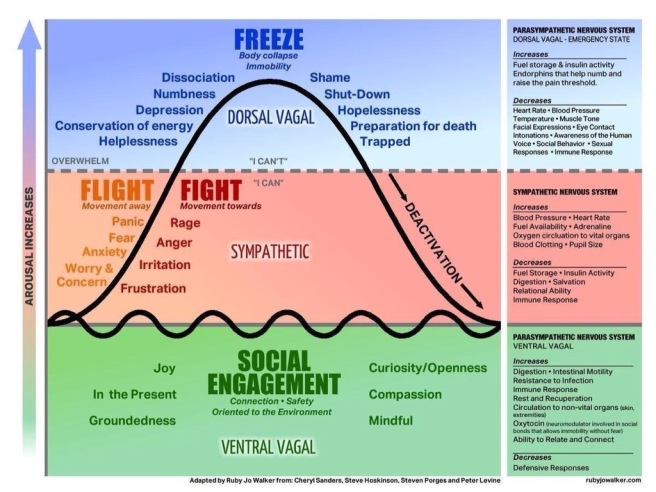
In any situation, a child’s brain is neuroceptively (fast and unconsciously) assessing environmental safety.  Many children find school a reasonably safe place and respond accordingly; some will find school and learning unsafe. This blog does apply to all children, but focuses by illustration on children who have experienced adverse childhood experiences. If a child’s  life  means that their experience of things is fraught with danger signals, then the child’s ANS will be sending danger signals to the rest of the brain and to the body. The child will then excessively look for danger in the EXTERNAL environment and excessively experience danger INTERNALLY – even from the most unfathomable of stimuli; when we experience an internal feeling of danger we tend to look externally for the source. This chart by Ruby Jo Walker highlights it well.

IMG_0435

According to Stephen Porges, who has pioneered work on the role of the vagal nerve, the ANS operates on a continuum of response from complete safety to extreme danger. It is helpful to divide this up into three zones of SAFETY, DANGER and LIFETHREAT. When the ANS judges both internal and external environment to be safe then this represents a child’s optimal arousal level. In this state, the child is most ready to learn. This is not about an element of challenge or stress but the assessed absence of danger. It is this state, that most children are in when in school, that is elusive for the child who has experienced significant adverse life experiences.

A child with the above issues exists far more with the ANS in a state of readiness for danger or even life threat – even if no such threat exists in the environmentA danger state is represented by hyperarousal and readiness for fight, flight, rage or panic. A life threat state is represented by hypoarousal, freeze, dissociation and collapse. When someone has an extreme phobic response to a relatively innocent stimulus then this is what is happening.

This understanding sheds some light on the issues surrounding these often very difficult to manage children. We tend to look at our external environmental strategies to see if they will work and often cannot see why they don’t work. However, these strategies simply will not work if the ANS is experiencing the external or internal child environment as dangerous. Where does this leave us then? Our focus needs to be on getting the ANS in the right place rather than on the poor behaviour resulting from the ANS response. Quite simply we also would behave in inappropriate ways if our ANS was misfiring in this way. When working with these children it is helpful for us to acknowledge poor behaviour and response to learning as adaptive rather than maladaptive. That leads us to the question, ‘Why might this behaviour be adaptive?’. Once we have asked ourselves that question it can lead us forward in our search for good solutions.

We can take three routes to modifying the ANS response and in ‘learning the child’, we can try to find the right combination of routes. The first route works primarily on the body and physiological response generated by the ANS. The second route works primarily on the emotional state itself to create a sense of safety. The third route works on the cognitive (executive function) ability to apply a brake to the ANS. This whole brain way of working represents a powerful model for working with these children.

 As teachers we need to ‘stand still in order to move on’. This means finding the time to stand back and ask the question ‘ Could this behaviour be signalling something more than is immediately obvious? By being prepared to view behaviour as a signal of adaptation gives us the space to become thoughtful and reflective rather than reactive. It enables us to be better teachers and children to learn better.

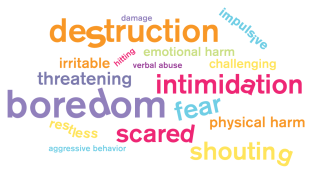
Having run a workshop on this a number of times it has become clear educators need solutions. The main solution is re-labelling the behaviour you see as fight or flight. Imagine someone with a propensity for car rage next to you in a car, raging at the traffic – how do you talk to them? What makes them worse? Tell them to stop swearing and they’ll swear directly at you in response! What about if there was a child on a climbing centre rock wall, frozen mid climb? How would you talk to them? What would you say? You certainly wouldn’t threaten them with a sanction if they didn’t move forward! You tell them about how the rope is making them safe. That everyone does this every day and is always safe. To take their time and then when they are ready take tentative steps. Relabel the behaviour and then approach the situation with the right tools. Once you have a relationship, they’ll respond quicker to you when you use the tools. It’s hard having a heightened ANS system, be sympathetic to them. Recognise how hard it must be to live life on the edge of fight or flight constantly and how that gets in the way of learning.

The Limits of Educational Research – Part 1: John Sweller

pexels-photo-707676.jpeg

Stop all the clocks, cut off the telephone,

Prevent the dog from barking with the juicy bone.

Silence the pianos and, with muffled drum,

Bring out the school bell. Let the learners come.

(Adapted from, and with apologies to, WH Auden)

Few people who hear the poem adapted above, realise that WH Auden originally wrote it as a piece of satire, mocking the sort of eulogies that are  delivered for public figures who don’t really deserve them.  The fact that the poem is often seen as and used as, a heartfelt tribute at funerals, suggests that it is easy to misrepresent  a poet’s intentions by making use of their work in such a way that its original meaning is lost, and the same might be said of educational research. John Sweller’s work on cognitive load is often promoted by a group of teachers and researchers who have come to be identified as “the neo-trads” or neo-traditionalists.  However, just like when a legion of summative assessors leapt misguidedly upon the Black and Wiliam Black Box and nearly broke the system with their enthusiasm for inefficient assessment of work and learning, so we need to be careful before doing the same with Sweller’s work on Cognitive Load Theory (CLT).

Sweller is working just as hard as Wiliam did in correcting misunderstandings about his work. Like any good researcher, Sweller acknowledges the limitations of his work. And it is these limitations which fail to cross the divide from research to school teaching that we need to pause and reflect upon.

Many people forget that Sweller accepts the constructivist view of learning – namely that we learn because of a set of mental structures (often referred to as schemata) which allow us to construct meanings and information from that which we perceive of the outside world. The difference for Sweller is what this means for teachers. For social constructivists, like Jerome Bruner, this construction is facilitated through the individual’s interaction with others and the world they inhabit. It is a journey of discovery rather than a  guided path. For Sweller, this is the problem. The mental structures with which with he is concerned need to be built in a particular way, and this is where the teacher comes in. They must teach certain things in certain ways which develop the architecture of the schema, allowing them to be stored in the individual’s long term memory. For Sweller, teaching methods which allow students to discover things for themselves do not do this.

But…..Sweller is clear that his ideas do not constitute “ a theory of everything”. Most of the data which supports his theory comes from the subject domains of Maths and Science. He doesn’t feel that Cognitive Load Theory works as a way of informing instructional design unless what is being learnt has a high level of what he calls “element interactivity”, namely, the number of different elements that must be considered simultaneously in the instance of learning – say, something like a complex equation. Interestingly, an Australian academic called Arianne Rourke has tried to apply Sweller’s ideas to the Art classroom , but only in the sense of using worked examples to teach students about the history of design and designers – an area of Art education that we might see as being largely a matter factual information, rather than the affective matter of expression or interpretation.

The real problem with CLT then, would appear to be its adaptability and scalability. Can it, as a basis for instructional design, be adapted to subjects like Drama, Geography or DT? Probably not, though it might be worth thinking about areas of these subjects where CLT might have an application? Could it be scaled properly across schools so that everyone was using it to inform their teaching? Again, probably not, but some teachers might benefit from thinking about cognitive load and where this idea was advantaging or disadvantaging learning.