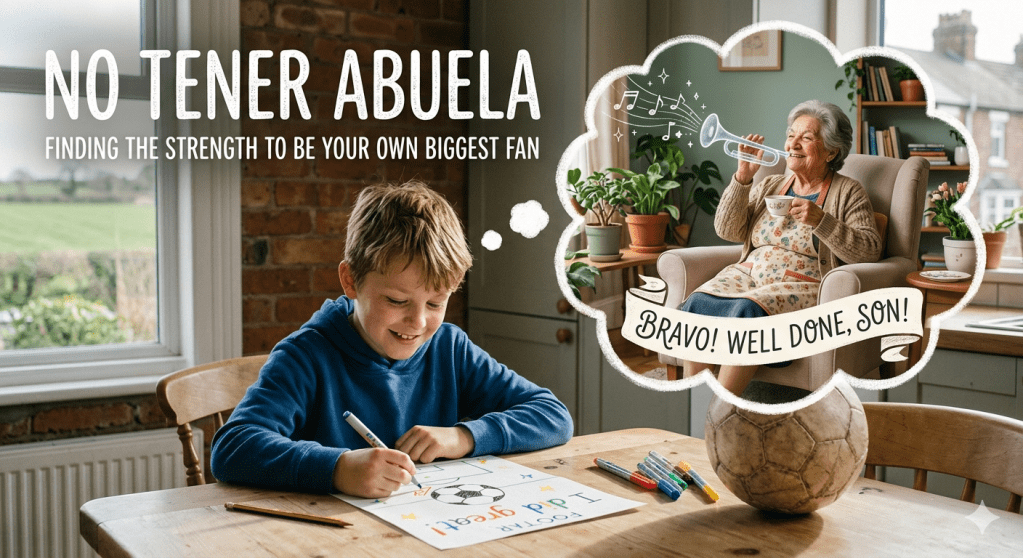
Why we all need a grandmother in our heads – no tener abuela

No tener abuela is a light hearted comment made by Spanish speakers to someone who is self-congratulatory. It roughly translates to someone without a grandmother to provide the congratulatory praise so they provide it for themselves.

The concept of no tener abuela can be a cultural lens through which we can re-examine the British relationship with ambition and self-worth. In the UK, particularly within working-class communities, there is a long-standing tradition of policing self-praise. Friedman and Laurison’s work is a good primer on this. Phrases such as ‘too big for your boots’ or ‘your head won’t fit through the door’ are often deployed as a means of maintaining humility. Yet, these cautions can inadvertently create a barrier to personal growth, suggesting that acknowledging one’s success is a form of class betrayal or an act of arrogance.

In reality, learning to be self-congratulatory, especially in the absence of a symbolic, doting grandmother to do it for you, is a sophisticated strand of metacognition. It is the practice of stepping outside oneself to objectively evaluate and celebrate an achievement – even if knowing when to articulate those thoughts is yet another cultural norm to navigate.

Moving beyond material evidence

When we discourage children from thinking or saying ‘I smashed it’, we often force them to look elsewhere for evidence of their success. If a child cannot rely on their own internal voice for validation, they inevitably turn to tangible substitutes:

  • Material rewards: stickers, toys, or money.
  • Social validation: digital dopamine from likes and shares.
  • Outcome-bias: only valuing efforts that result in a ‘win’ or a ‘payday’.

By relying solely on these external markers, we risk fostering a purely transactional relationship with effort. If an achievement does not earn anything visible, a child may begin to view the effort itself as valueless.

The power of internalised praise

The reward for playing a brilliant game of football or tennis should not be restricted to the trophy or the praise from the sidelines. The most enduring reward is the ability to reflect and acknowledge one’s own performance: “Well done, I played excellently.” Whether it is writing a short story at school or volunteering for a charity, children should learn to internalise this praise, finding genuine satisfaction in their own efforts. While they must eventually navigate the cultural nuances of how and when to voice this pride to others, the foundational skill is the ability to validate oneself

Teaching children to share these moments with those close to them, not as a boast but as an honest assessment of their own hard work, is a vital social mobility skillset. It provides a buffer against the pervasive fear of overreaching, allowing them to value the process of improvement even when there is no immediate financial or material reward. By learning to articulate their own value, they cultivate a durable sense of self-worth that remains steady, even when external validation from their community is withheld or actively discouraged.

Self-congratulation as a tool for strength

Developing this internal grandmother is not about vanity: it is about becoming stronger. It is an essential component of self-regulation and mental health. When a person can look at their own performance and find satisfaction without needing an audience, they become less susceptible to the fluctuations of public opinion or the addictive pull of short-term rewards.

We should encourage the next generation to embrace a touch of the grandmotherless spirit. If you have done something great, you should be the first person to recognise it. Valuing the things that lead us to reflect, ‘you did great,’ is the surest way to build a life defined by authentic purpose rather than material accumulation.

Revolutionise Learning with National Education Service AI Technologies

Imagine glancing into the near future of education. In Sweden, Lexplore uses AI-powered eye-tracking not just to assess reading, but to actively screen children for potential difficulties like dyslexia, identifying needs often before they become entrenched problems. What’s striking isn’t just the technology; it’s the philosophy. This feels less like conventional testing or inspection, and more akin to a proactive health service identifying risks and enabling early support. Could this preventative, diagnostic approach be a model for England’s Department for Education?

The UK’s National Health Service operates on a foundational principle: catch health issues early through reliable and inexpensive screening. Interventions triggered by timely screening are invariably more personalised, cheaper, more successful, and less intrusive. Think about developmental checks for babies or targeted screening programmes for adults based on age and risk factors – it’s not a one-size-fits-all annual exam for everyone simultaneously. What if we applied this proven, preventative philosophy to education, but converged with the power of AI?

We stand at the cusp of an explosion in convergence between artificial intelligence and educational technology. AI is rapidly moving beyond simple automation; it can increasingly ‘observe’ and analyse the process of learning. Imagine systems that don’t just mark a final answer, but watch how a pupil reads – tracking eye movements for fluency and comprehension indicators. Picture AI analysing handwriting formation for potential motor control issues or even just letter formation; identifying patterns in mathematical problem-solving that might suggest dyscalculia or misconceptions; observing collaborative interactions in virtual environments; or even assessing biomechanical efficiency in PE. While acknowledging the critical ethical considerations around data privacy and algorithmic bias that must be addressed, the potential for deep, nuanced understanding of individual learning is immense. And it will arrive. Don’t think the tidal wave of AI is going to miss education. It’s going to cover every single bit of it.

This capability of AI allows us to envision a shift away from assessing children primarily to measure school performance, towards screening individuals to understand their specific needs. Contrast this with our current reliance on blunt, mass-approach strategies. Pupil Premium funding, while well-intentioned, often lacks the granular data to target underlying needs effectively. Large-scale EEF randomised controlled trials dictate averaged-out ‘best practices’ that may not suit every child or context. Rigid, centrally mandated phonics schemes meet pupils at varying developmental stages.

Consider the annual phonics screening check – the infamous graph plotting average scores by birth month, a near-perfect downward slope from September to August-born children, is a stark illustration. It highlights the absurdity of assessing every child at the same chronological point, ignoring months of developmental difference. The check itself may have value, but the one-size-fits-all process is flawed. It’s a system designed for cohort-level data collection, not individual diagnosis. Similarly, high-stakes standardised tests often narrow the curriculum, induce stress, and provide only a snapshot in time, failing to capture progress, promote creativity, or cultivate critical thinking.

Imagine, instead, dynamic, AI-powered screening. Phonics checks could be triggered by birth month, not school year cohort. Algorithms could identify children needing earlier or more frequent screening based on a growing profile of risk factors – perhaps language delay, family history, or early indicators from those AI observations of reading or writing. A five-year-old wearing an eye patch for 18 months wouldn’t just potentially ‘fail’ a single test; their progress could be sensitively tracked via regular screening against national benchmarks for learners with similar challenges.

The data generated wouldn’t primarily serve to rank schools, a practice often misleading given the vast differences in intake, funding, and context. Instead, it would empower precise, personalised interventions. AI analysis identifying specific phoneme difficulties could trigger targeted support from a school’s in-house reading specialist. Real-time assessment of maths understanding could dynamically adjust adaptive learning software. Observed motor control difficulties could lead to specific occupational therapy recommendations. This approach allows resources – human expertise, tailored software, specific aids – to be channelled effectively, supporting a child directly.

Scaling this vision creates a powerful national dataset focused on children’s learning needs and progression trajectories, not crude school comparisons. This brings us back to the idea of a “National Education Service.” While the term was politically championed by Labour in recent years with a focus on universal access and lifelong learning, this technologically-enabled vision offers a different emphasis: a service philosophy built on proactive, individualised screening and support. It uses AI not for judgment, but for deep understanding, enabling interventions that are early, cost-effective, successful, and minimally intrusive where possible.

Isn’t it time the DfE seriously considered shifting its focus from ranking schools through mass assessment to truly nurturing every child’s potential through intelligent, personalised screening? Perhaps a reimagined NES, powered by ethical AI, is the future. It’s already happening at an elite sport level, so why not be bold and have a plan to use it for every child in the country.

Dr James Shea @englishspecial

Image of elite sport using AI to ‘watch’ a player’s perfomance