“Whatever people say I am, that’s what I’m not”: Renewing perceptions of Teacher Education in the UK

pexels-photo-301926.jpeg

About a year ago, the Head of our School of Teacher Education, Juliet Fern, wrote an article in the Guardian, suggesting that Universities should take a more advanced role in the way that teachers get trained later on in their career, as a way of helping stop some of the problems that we have with teacher retention in this country. What was most revealing to us as a group of academics were the “below the line” comments concerning what Juliet had written.

In between the widespread apathy and general derision towards the idea of Universities playing any kind of role in teacher education, there was a huge amount of misunderstanding and a significant lack of knowledge about what it is that teams like the one we belong to here at UOB are trying to do. Like the character of Arthur Seaton, (from Alan Sillitoe’s Saturday Night and Sunday Morning, whose words above were  subsequently appropriated by the Arctic Monkeys)  we felt the need to address what people think they know about us.

Currently, we’re considering in some detail about what our PGCE should really be like. This is because we’re involved in one of those review processes that Universities conduct on a semi-regular basis. However, instead of seeing this as a box-ticking exercise, we’ve taken the opportunity, as a team, to think very carefully about what it is we believe in. A close look at the comments below Juliet’s article would suggest that we don’t believe in (or know) very much, but this is a public narrative that we would want to challenge. The fine detail can be found  in our PGCE Rationale Document  but perhaps more succinctly, the kind of teacher education we pursue here at UoB is about three things

  1. A pluralistic approach to teaching and learning
  2. Creating a mobile, but sustainable workforce
  3. Developing teachers who can think for themselves

That first one is from an academic point of view, the most important. At the heart of the PGCE course is the notion that trainees need to recognise that there are many ways of teaching the young people that we work with and that this recognition requires that they think about how they view things like knowledge, skills, pedagogy and evidence. For us as academics, it means exposing them to as many different perspectives on teaching and learning as possible, but also acknowledging that this exposure needs to happen in philosophical and theoretical terms as well as practical ones. Consequently, we are unapologetic about teaching a range of philosophical and theoretical ideas about education alongside practical strategies that trainees need in the classroom.  Recent work by Steve Courtney from the University of Manchester makes this argument better than we can, but suffice to say this first principle of teacher education is tied into a belief that teacher education must be, at least, partly located in the University, and not wholly in schools.

From a professional point of view, the second principle is most important. More than ever, we need a mobile workforce, who can work in a range of different environments. We are fortunate that we have a diverse school partnership here at UoB, from the neo-traditional to the progressive and also those who reject this dichotomy. Our trainees need to be able to work in these environments and everywhere in between, and our PGCE must prepare them for this, even if the trainees don’t personally concur with the educational philosophy of a particular setting. This level of preparedness is essential in a time of massive teacher shortages.

Finally, we would conjecture that those teacher shortages have occurred because of an inability to get teachers to do the third thing on our list. We are interested in developing teachers who stay in the profession for the long term, mainly by encouraging them to think beyond their immediate environment, and to think about the bigger picture; so not asking just, “How can I contribute to this school?” but also, “How can I contribute to the wider profession through my work in a number of schools?” . Not just “Can I get a job?” but “Can I get the right job for me?”. Not just “What do I need to know to pass this course?”, but ” What do I need to know to make a successful go of the profession?” This kind of sustainable thinking about teacher education is what Juliet Fern was hinting about in her original article. It is the kind of approach to teacher education we have seen in  the Netherlands, which has, historically at least, seen much better teacher retention rates.

It is also, as Viv Ellis has pointed out, similar to the approach of the Norwegians – an education system refreshingly free of some of the simplistic debate about teacher education seen on social media. We believe that this approach will produce a more resilient, more professional, more academically engaged and more effective teaching profession. Interestingly, a number of colleagues from other institutions agree with us and we particularly welcome Teacher Education Exchange’s comments on Subject Knowledge, which are in sharp contrast to some other developments in this area (It is worth noting, that many items on the Brierly Price Prior (BPP)PGCE reading list are also on ours – pluralism has advantages for everyone!) We also believe that we will make mistakes along the way, but like all education, these are the things we learn from.
Understanding the effect of the Autonomous Nervous System on children’s behaviour

behaviour management

One model of explanation often applied in determining the learning and behaviour of any  child is the state their Autonomous Nervous System (ANS) is in. It is worth knowing a bit about this as the ANS gene expression is changed by poor early attachment experiences, excessive stress and trauma.

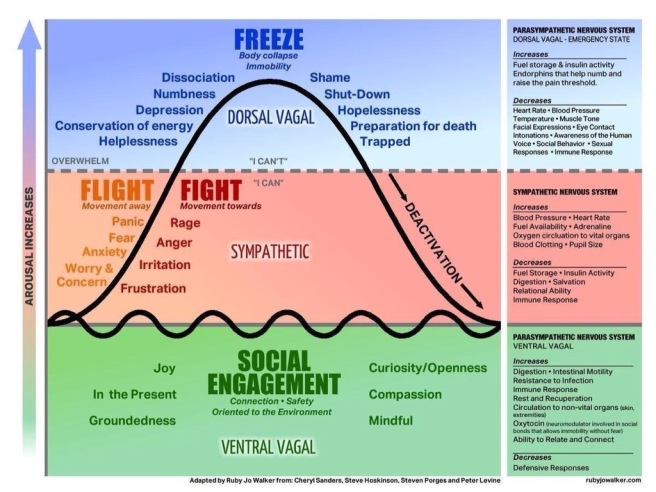
In any situation, a child’s brain is neuroceptively (fast and unconsciously) assessing environmental safety.  Many children find school a reasonably safe place and respond accordingly; some will find school and learning unsafe. This blog does apply to all children, but focuses by illustration on children who have experienced adverse childhood experiences. If a child’s  life  means that their experience of things is fraught with danger signals, then the child’s ANS will be sending danger signals to the rest of the brain and to the body. The child will then excessively look for danger in the EXTERNAL environment and excessively experience danger INTERNALLY – even from the most unfathomable of stimuli; when we experience an internal feeling of danger we tend to look externally for the source. This chart by Ruby Jo Walker highlights it well.

IMG_0435

According to Stephen Porges, who has pioneered work on the role of the vagal nerve, the ANS operates on a continuum of response from complete safety to extreme danger. It is helpful to divide this up into three zones of SAFETY, DANGER and LIFETHREAT. When the ANS judges both internal and external environment to be safe then this represents a child’s optimal arousal level. In this state, the child is most ready to learn. This is not about an element of challenge or stress but the assessed absence of danger. It is this state, that most children are in when in school, that is elusive for the child who has experienced significant adverse life experiences.

A child with the above issues exists far more with the ANS in a state of readiness for danger or even life threat – even if no such threat exists in the environmentA danger state is represented by hyperarousal and readiness for fight, flight, rage or panic. A life threat state is represented by hypoarousal, freeze, dissociation and collapse. When someone has an extreme phobic response to a relatively innocent stimulus then this is what is happening.

This understanding sheds some light on the issues surrounding these often very difficult to manage children. We tend to look at our external environmental strategies to see if they will work and often cannot see why they don’t work. However, these strategies simply will not work if the ANS is experiencing the external or internal child environment as dangerous. Where does this leave us then? Our focus needs to be on getting the ANS in the right place rather than on the poor behaviour resulting from the ANS response. Quite simply we also would behave in inappropriate ways if our ANS was misfiring in this way. When working with these children it is helpful for us to acknowledge poor behaviour and response to learning as adaptive rather than maladaptive. That leads us to the question, ‘Why might this behaviour be adaptive?’. Once we have asked ourselves that question it can lead us forward in our search for good solutions.

We can take three routes to modifying the ANS response and in ‘learning the child’, we can try to find the right combination of routes. The first route works primarily on the body and physiological response generated by the ANS. The second route works primarily on the emotional state itself to create a sense of safety. The third route works on the cognitive (executive function) ability to apply a brake to the ANS. This whole brain way of working represents a powerful model for working with these children.

 As teachers we need to ‘stand still in order to move on’. This means finding the time to stand back and ask the question ‘ Could this behaviour be signalling something more than is immediately obvious? By being prepared to view behaviour as a signal of adaptation gives us the space to become thoughtful and reflective rather than reactive. It enables us to be better teachers and children to learn better.

Having run a workshop on this a number of times it has become clear educators need solutions. The main solution is re-labelling the behaviour you see as fight or flight. Imagine someone with a propensity for car rage next to you in a car, raging at the traffic – how do you talk to them? What makes them worse? Tell them to stop swearing and they’ll swear directly at you in response! What about if there was a child on a climbing centre rock wall, frozen mid climb? How would you talk to them? What would you say? You certainly wouldn’t threaten them with a sanction if they didn’t move forward! You tell them about how the rope is making them safe. That everyone does this every day and is always safe. To take their time and then when they are ready take tentative steps. Relabel the behaviour and then approach the situation with the right tools. Once you have a relationship, they’ll respond quicker to you when you use the tools. It’s hard having a heightened ANS system, be sympathetic to them. Recognise how hard it must be to live life on the edge of fight or flight constantly and how that gets in the way of learning.

The Limits of Educational Research – Part 1: John Sweller

pexels-photo-707676.jpeg

Stop all the clocks, cut off the telephone,

Prevent the dog from barking with the juicy bone.

Silence the pianos and, with muffled drum,

Bring out the school bell. Let the learners come.

(Adapted from, and with apologies to, WH Auden)

Few people who hear the poem adapted above, realise that WH Auden originally wrote it as a piece of satire, mocking the sort of eulogies that are  delivered for public figures who don’t really deserve them.  The fact that the poem is often seen as and used as, a heartfelt tribute at funerals, suggests that it is easy to misrepresent  a poet’s intentions by making use of their work in such a way that its original meaning is lost, and the same might be said of educational research. John Sweller’s work on cognitive load is often promoted by a group of teachers and researchers who have come to be identified as “the neo-trads” or neo-traditionalists.  However, just like when a legion of summative assessors leapt misguidedly upon the Black and Wiliam Black Box and nearly broke the system with their enthusiasm for inefficient assessment of work and learning, so we need to be careful before doing the same with Sweller’s work on Cognitive Load Theory (CLT).

Sweller is working just as hard as Wiliam did in correcting misunderstandings about his work. Like any good researcher, Sweller acknowledges the limitations of his work. And it is these limitations which fail to cross the divide from research to school teaching that we need to pause and reflect upon.

Many people forget that Sweller accepts the constructivist view of learning – namely that we learn because of a set of mental structures (often referred to as schemata) which allow us to construct meanings and information from that which we perceive of the outside world. The difference for Sweller is what this means for teachers. For social constructivists, like Jerome Bruner, this construction is facilitated through the individual’s interaction with others and the world they inhabit. It is a journey of discovery rather than a  guided path. For Sweller, this is the problem. The mental structures with which with he is concerned need to be built in a particular way, and this is where the teacher comes in. They must teach certain things in certain ways which develop the architecture of the schema, allowing them to be stored in the individual’s long term memory. For Sweller, teaching methods which allow students to discover things for themselves do not do this.

But…..Sweller is clear that his ideas do not constitute “ a theory of everything”. Most of the data which supports his theory comes from the subject domains of Maths and Science. He doesn’t feel that Cognitive Load Theory works as a way of informing instructional design unless what is being learnt has a high level of what he calls “element interactivity”, namely, the number of different elements that must be considered simultaneously in the instance of learning – say, something like a complex equation. Interestingly, an Australian academic called Arianne Rourke has tried to apply Sweller’s ideas to the Art classroom , but only in the sense of using worked examples to teach students about the history of design and designers – an area of Art education that we might see as being largely a matter factual information, rather than the affective matter of expression or interpretation.

The real problem with CLT then, would appear to be its adaptability and scalability. Can it, as a basis for instructional design, be adapted to subjects like Drama, Geography or DT? Probably not, though it might be worth thinking about areas of these subjects where CLT might have an application? Could it be scaled properly across schools so that everyone was using it to inform their teaching? Again, probably not, but some teachers might benefit from thinking about cognitive load and where this idea was advantaging or disadvantaging learning.