
Teacher well-being: it’s not about the doughnuts!

Photo by Lisa Fotios on Pexels.com

Back in 2008, Gwyneth Paltrow started sending out a newsletter for her Gloop empire. It was founded on a simple premise: ‘being well’ was no longer defined by ‘not being unwell’. Being well means actively preventing harmful things from entering your body or mind as well as actively undertaking behaviour which leads to a healthier body and mind.

Dial back to the message being sent out to teachers in that 2000s era and it’s about ‘resilience’ and preventing snowflake teachers from wimping out of the hard yards of being a teacher. It was only when they noticed huge numbers of teachers leaving the profession that they started to really take these things seriously and we started to see initiatives about well-being and workload being brought in. And some of these initiatives have had an impact. Certainly the ‘deep marking’ years of triple coloured pens seem to be finally behind us. The ‘verbal feedback stamp’ has been ground down to a pernicious stubborn nub. But all of these things are not really getting to grips with just what we need to do with our profession.

If wellbeing is no longer ‘not being unwell’, what alternative definitions are there? Cambridge University’s Wellbeing Strategy and Policy offers “Creating an environment to promote a state of contentment which allows an employee to flourish and achieve their full potential for the benefit of themselves and their organisation”. The DfE offer an Education Staff Wellbeing Charter which says wellbeing is “A state of complete physical and mental health that is characterised by high quality social relationships” saying soberly and perhaps presciently “it is critical in recruiting and retaining high quality education staff now and in the future”.

When a teacher has to work extraordinarily long days and weekends, sacrificing time that could be spent with their family or on their health – the effect is not just tired teachers. It’s teachers without well-being. Teachers unable to achieve well-being directly because of their profession. It’s effectively like being unwell. These teachers know that their job is harming their personal physical health and they know it is harming their relationships with people important to them. In teaching, there’s little flexibility alas. You either work long hard hours or you move schools to a school that doesn’t make you work long hard hours, or you change profession. But don’t people in non-teaching jobs work long hard hours? Sure, but not every week, every weekend and week in and week out. And if they do, they’ve got a similar problem with well-being or it’s likely their employer are offering something else which people accept to offset the harm – such as a high salary.

When you see a school offering doughnuts, or well-being days – it is easy to think these are good things. However, it’s not really targeting well-being. A reduction in workload initiative which hands back time to a teacher to spend with their family is much more powerful as a well-being initiative. When teachers are stressed from work intensity, behaviour management issues or even toxic colleagues and managers then this causes cortisol levels to rise. Today, instead of having resilience to high cortisol levels, teachers are increasingly leaving the source of this stress and finding alternative places of employment. It’s why leadership and retention of staff is seen as so important. Whilst praise and appreciation of the hard work and sufferance undertaken by a teacher is sometimes well received, it does not remove the source of the workload or the stress. Teachers all pull hard on singular occasions – a school play or a parents’ evening. But when it happens every week the praise starts to wear thin.

In some trusts, the job descriptions and role outlines are clear – you are expected to have a worklife balance whether you are M1 or UPS. In some trusts, the job descriptions are the opposite. We all remember ”that” advert: “High energy and sacrifice are required to excel in this position. We cannot carry anyone. We need a commitment from our assistant headteacher to stay until the job is done.” The suggested hours of 7am to 6pm are beyond those with young children or upper pastoral care responsibilities. Should some roles really be exclusively for those without children or responsibilities?

That is not to say teachers cannot work hard without harming themselves. Going to see plays, visiting a museum, listening to a show on Radio 4, getting up early on a Saturday to travel to a ResearchEd event are all extra hours related to work, but they are not toxic hours. There is a balance to be had.

When I look at parts of the profession, I see harm to well-being and unwell teachers. We know that toxic people lurk in our profession. We know that no matter what Ofsted does to its inspection framework, its inspection process causes perpetual harm and a constant state of unwellness to those in our profession. It needs to rethink just how the process does this. Is it possible to protect children through safe-guarding and ensure high standards of teaching with less harm? The constant threat of inspection reduces well-being across the profession and some of Ofsted’s work clearly pushes teachers out of schools and out of teaching. It’s not about developing resilience and toughening up snowflakes any more. It is about cultivating healthy well-being and that means our profession is driving teachers away from teaching because these teachers want to be actively healthy and if they cannot achieve it in teaching they will leave and find a place where they can.

Working memory of teachers – how anxiety affects quality of teaching

We all recall our first foray into teaching as a beginning teacher. Trying to manage the technology of SIMs for the register, meeting and greeting pupils at the door, remembering which childen have specific needs, checking for uniform, managing resources – it seemed to be there were so many things to remember and undertake. And then if you had behavioural issues as well – it could easily all overwhelm you. As experienced teachers, we know that behaviour, interruptions to our classrooms, faulty equipment and so forth, can intervene and make the basic job of teaching and adaptation exceptionally hard. But have you thought about looking at this from the perspective of cognitive science? In particular the focus on working memory?

Working memory has limitations. That’s readily established. It depends on a number of contextual factors, but regardless of those variables, it’s limited. Load it up too much with extraneous load and it stops the basic intrinsic task from being undertaken so easily. We think about this all the time for our pupils, but have we thought about it from the lens of a teacher?

There’s an interesting 2019 paper from Angelidis et al., on how acute cognitive performance anxiety increases threat-interference and impairs working memory performance. It starts from a readily established academic position that we all know about: if you stress about a situational context it affects your ability to do the task. Whether it’s public speaking or playing sport – anxiety can impair the execution. What the paper then goes on to do is to measure working memory using an established psychological test. They then cultivated stress through an established psychological method (ironically, for us as teachers, the stress is created by asking participants to perform a mathematical task whilst receiving scripted negative feedback. Maths anxiety really does need more focus!). What they discovered was that loading up the stress impaired working memory. Now to be clear, the paper acknowledges that it is established academically that some stress is helpful. Too little stress and you underperform. In particular, the focus is on anxiety, not just stress. The paper concludes anxiety is counter-productive to working memory.

Starting from this premise then, you begin to reflect on what teachers use working memory for and what things might impair this capacity. This is in no way comprehensive, but let us look at some basics.

Teachers use working memory to:

1.       Teach – the things we said at the start: managing resources, organising the lesson, asking questions, developing answers and so forth.

2.       To adapt. I separate this out because it relies on constant monitoring of students, how well they are undertaking a task and then intervening and adapting. It happens constantly and continuously as a teacher ensures that adaptation takes place and a feedback rich environment is present.

3.       Recall subject knowledge from long-term memory and apply it to the lesson.

4.       Monitor and manage behaviour. Again, there is a constant focus on behaviour as the teacher scans and ensures attention (and I use that term academically, e.g. attentional control) is maximised throughout the lesson. Very quickly we can see how too much overload, anxiety-related or simple overload could overwhelm working memory here.

5.       Follow non-negotiables. There will be tasks that always have to be followed regardless of the flow of lessons and we note that this is quite the debate in educational circles where they can be seen as unnecessary or interfere with a teacher’s ability to undertake other tasks.

6.       Ensure Ofsted compliance is being followed. I don’t know any teacher who doesn’t think about Ofsted and how they might ‘view’ the things that happen in the classroom. Writing, reading, marking – and if the school is expecting an Ofsted inspection there could be anxiety pushed onto teachers from SLT.

7.       Adult on adult bullying in the school workplace. Hierarchical, horizontal – it doesn’t matter. We all know it exists and is driving teachers from the profession. Half of the stories from that Facebook group for teachers that have left or are leaving the profession cite adult on adult bullying as the cause. That this stress can then impair teacher working memory and thus ability to teach shows that we have to be very careful in this area.

7.       Thinking about the observer’s thoughts before, during and after an observation. Anxiety about an observation can affect the very thing the observer is trying to observe.

8.       Non-teaching things. Let’s be honest here. Teachers are human. They think about divorce, children, bills, cancer, family, relationships, physical and mental health and so forth. These things could be very much related to anxiety and providing what the paper calls ‘threat-interference’ to their working memory capacity.

Quite quickly, we can all see that there are multitudes of stresses and anxiety-inducing factors that could reduce the capacity of a teacher’s working memory. There are also key pinch points in the year where anxiety and stress are high – parents’ evenings or during mock exam marking season for example. All these sources of stress would then have a direct impact on the positive things that we would like teachers to spend that working memory on. But not all stress is bad remember. Reviewing children’s access to learning and introducing adaptation is a healthy stress – it requires careful monitoring and intervention. Creating a feedback rich environment is helpful, but stressful. In a good way. Thinking hard about questions and questioning takes working memory capacity. Recalling subject knowledge really does need working memory capacity and focus and is eminently helpful for the lesson. But if you are trying to cope with poor behaviour then recalling subject knowledge becomes more challenging. If you have anxiety about poor behaviour, even when the behaviour isn’t present, it still affects working memory.

If we are to keep teachers in the profession then we have to focus on the working memory of teachers, not just pupils. We need to think about tackling things like poor behaviour. We need to question ourselves about the helpfulness and accuracy of observations as well as reflect on the impact of the anxiety produced in teachers by Ofsted and even things like non-negotiables. We should be focused on ensuring that things like providing support for teachers going through challenging times with family and health are readily available. Doing things such as these can free up capacity in working memory for the things that really matter in the lesson – the teaching and the adaptation. It’s time to focus on the working memory of teachers, not just pupils.

Dr James Shea https://twitter.com/englishspecial

As part of our ongoing work we periodically undertake research into areas of neuroscience and cognitive science and their application to teaching. If you are interested in being contacted in the future with a view to being a participant, please email james.shea@beds.ac.uk to be placed on a register of interested participants. If a suitable project becomes available in the future you will be contacted and offered an ethically vetted process to give consent to participate.

Time to forget Ebbinghaus’ forgetting curve?

Over the last decade, the conversation around cognitive science and psychology in education has grown ever louder, to the point at which these discourses have come to be seen as one of the dominant theories in contemporary education. Much of the discussion focuses on pedagogy including the role of memory and remembering, with theories of learning and teaching being based on the retrieval of information in the long term. Although the ability to remember information accurately is undoubtedly an important aspect of learning, forgetting is an important issue to consider when thinking about learning and seems to be not as widely discussed within education.

This blog will discuss the seminal work by Ebbinghaus and explore its role in the educational conversation and the many iterations of the forgetting curve which have emerged through teachers applying this to pedagogy.

Hermann Ebbinghaus

Ebbinghaus was an experimental psychologist who was interested in finding a mathematical relationship between the elapsed time post learning and forgetting. He conducted a number of experiments in the early 1880s in order to establish this.

In his experiments, Ebbinghaus attempted to learn a row of thirteen nonsense syllables until he was able to freely recall each one in the correct order. After a preset time interval, he would relearn the syllables, given the fact he had forgotten them, until he could once again freely recall each one in the correct order.  

It is important to recognise that Ebbinghaus’ view on forgetting was not a measure of how many syllables that could be recalled after a specific amount of time but the amount of time, or repetitions, it took to relearn the same list of syllables after forgetting. A measure he called savings. Savings can be presented as a decimal or a percentage and is calculated as follows:

If it took someone initially 10 minutes to learn the syllables but it only took them 8 minutes to relearn after a set time then the saving is 2 minutes. Savings is the 2/10 = 0.2

If the relearning took the same amount of time, then the savings would be 0 and if there was perfect recall without relearning, the saving would be 1 or 100%.

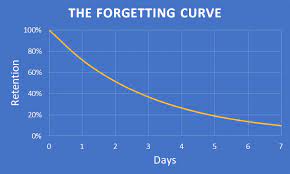
The original experimental results have been successfully replicated a number of times, but I am going to use data from the study by Murre and Dros in 2015 (paper can be found here) to discuss the forgetting curve due to the fidelity of their experiment. In their paper, Murre and Dros replicated Ebbinghaus’ experimental procedure and calculated savings using time. The resulting forgetting curve on a linear time scale is shown below:

The curve shows a general exponential decrease in savings. What is interesting is the higher than expected result for 1 day. Ebbinghaus also found this but he was able to fit the data point to the curve generated from his ‘forgetting equation’ so he overlooked this at the time. However, he did replicate, along with other subsequent researchers, this result after the publication of his work. This decrease or ‘slowing’ of forgetting from these experiments is thought to be due to the role of sleep in memory consolidation.

Interestingly, Murre and Dros recorded the number of correct responses (correct syllable in the correct position) during the relearning phases of their experiments. What this showed is that the proportion of correct answers after 20 minutes was marginally above 0.3 and this only decreased slightly at the longer time intervals.

Should we forget the curve?

From a position of experimental psychology the work of Ebbinghaus needs to be studied and remembered as it paved the way for psychology to have robust methods and rigour in the design of experiments that are still used today. The fact that the results of Ebbinghaus have been replicated a number of times is testament to this.

In terms of the educational conversation, it is useful to ask if we actually need a mathematical model (the graph with numbers) to tell us that learners forget. It is clear that what the Ebbinghaus’ forgetting curve does show is that:

1. a high proportion of information that is learnt is rapidly forgotten 

2. the longer you leave before relearning something, the longer it will take you to relearn

I think I would be hard pushed to find a teacher that genuinely would disagree with these statements, with or without knowledge of the curve. The question we ask then, what use does awareness of Ebbinghaus’ curve brings to a teacher beyond the knowledge that forgetting takes place over a period of time after the point of learning?

Certainly, the misinterpretation and misrepresentation of the curve is not helpful. Making claims like “you only remember x% of information after y time” is clearly untrue if you are using Ebbinghaus as your evidence base. Applying ideas like this to education is widely problematic and can result in unhelpful numbered things about forgetting, models like the infamous learning pyramid.

Additionally, there is a danger with using a mathematical model rather than just having good awareness that forgetting takes place and that there are well researched methods to remedy this. For example, we might say we forget 50% of something we have learned within an hour. This sounds plausible and whilst you might worry about all the different permutations, that’s the least of the problems. Using that premise, I could simply say, well I’ll double the information learned at the start and then they won’t forget what I intended them to learn. And of course, the teacher in you will say that’s nonsense.

Being focused on forgetting is a good thing, but it is important to think critically in our application of science just like Ebbinghaus himself was.